
Team meeting effectiveness: are your meetings good enough?

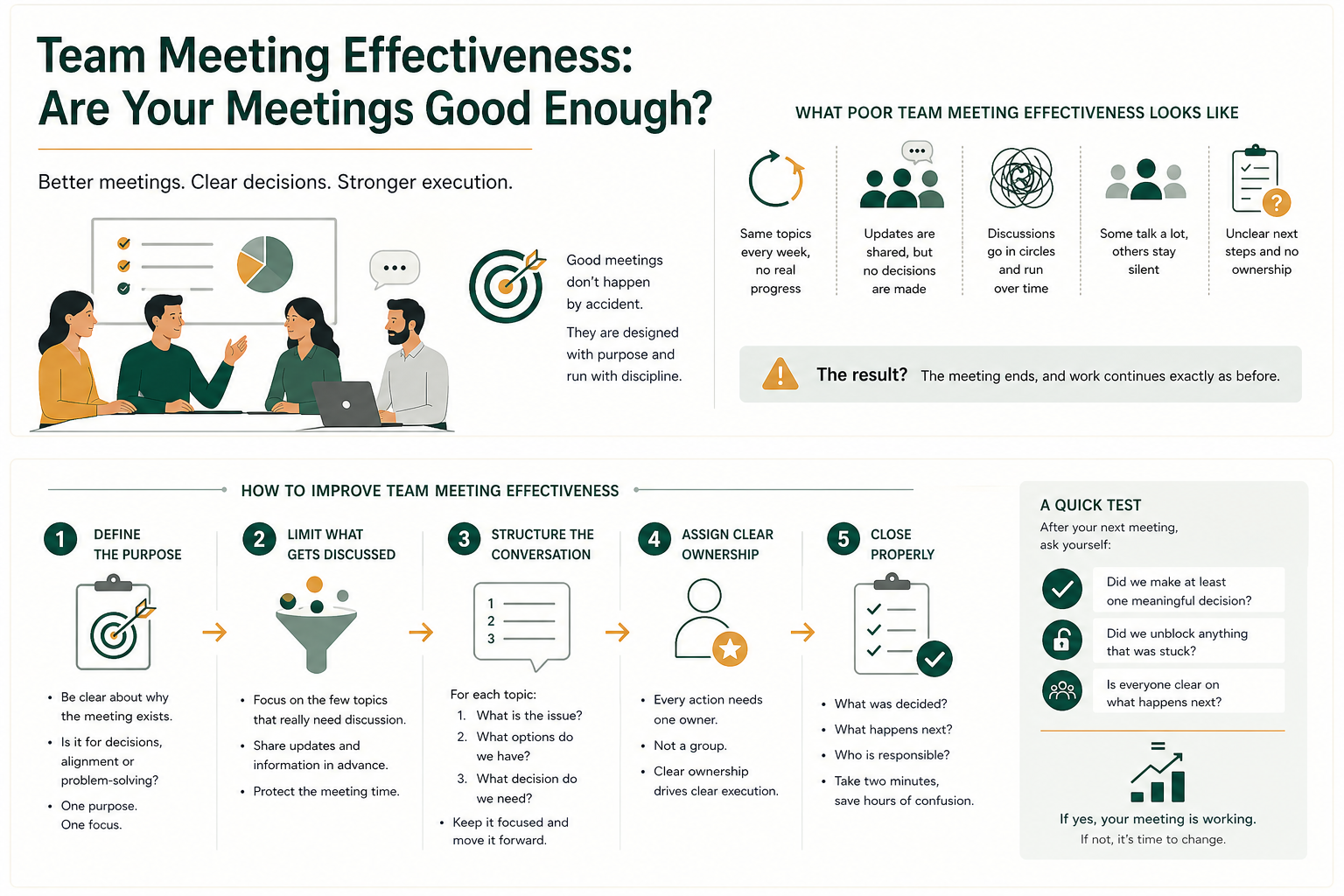
In reality, many meetings create noise instead of clarity. They take time without creating real progress.
This is not a people problem. It is a structure problem.
What poor team meeting effectiveness looks like
Most teams recognise these patterns immediately:
- The same topics come up every week with no real progress
- People share updates, but no one makes decisions
- Discussions go in circles and run over time
- Some people talk a lot while others stay silent
- No one is fully sure what happens next
The meeting ends, then work continues exactly as before.
Why most team meetings do not work
Most meetings are designed around habit, not purpose.
They exist because “we always have this meeting”, not because they serve a clear function.
As a result:
- The objective is unclear
- The structure is loose or inconsistent
- Decision ownership is missing
- Too much time is spent sharing information that could be written
Without structure, even strong teams struggle to make meetings useful.
This is why operational excellence and change management are often less about big transformation programmes and more about improving everyday ways of working.
What a good team meeting actually does
A good meeting is not about covering everything. It is about moving the right things forward.
At a minimum, every team meeting should do three things:
- Clarify priorities
- Unblock work
- Drive decisions
If your meeting does not achieve this, it is not doing its job.
How to improve team meeting effectiveness
You do not need a complex framework. You need clarity and discipline.
Start here.
1. Define the purpose
Be explicit. Is this meeting for decision-making, alignment or problem solving?
If everything is included, nothing is prioritised.
2. Limit what gets discussed
Not everything deserves airtime. Focus on the few topics that actually need discussion.
Everything else can be shared in advance.
3. Structure the conversation
For each topic, keep it simple:
- What is the issue?
- What options do we have?
- What decision do we need?
This removes a lot of unnecessary back-and-forth.
4. Assign clear ownership
Every action should have one owner. Not a group.
If ownership is unclear, execution will be unclear too.
5. Close properly
Before ending the meeting, confirm:
- What was decided
- What happens next
- Who is responsible
This takes two minutes and avoids a lot of confusion later.
A quick test for your next team meeting
After your next meeting, ask yourself:
- Did we make at least one meaningful decision?
- Did we unblock anything that was stuck?
- Is everyone clear on what happens next?
If the answer is no, the meeting needs to change.
Why this matters for execution
Meetings are not just a calendar problem. They are an execution problem.
When meetings are not good enough, decisions slow down, priorities drift and teams lose momentum.
However, when they work well, everything else becomes easier.
Better meetings do not require more time. They require better structure.
You can also explore practical examples of how we bring structure and visibility to teams in our case studies.
Final thought
Most teams do not need more meetings.
They need meetings that actually move things forward.
That is what team meeting effectiveness is really about.